Automation Doesn't Have to Mean Impersonal
The assumption that scale requires depersonalization is so embedded in enterprise communication that most teams accept it as fact. It isn't. It's a design choice — and it can be made differently.

The assumption that scale requires depersonalization is a design failure, not an inevitability.
Every organization wants to scale customer communication. The challenge is that scaling often comes with a perceived loss of empathy. Customers expect faster responses, but not colder conversations.
There is a version of automation that is efficient and cold. It handles volume. It reduces cost. It produces outputs that are correct and interactions that are forgettable.
Most people, when they think about automated phone systems, are thinking about this version.
It is not the only version.
The association between automation and impersonality is so deeply embedded in enterprise communication that it has become an assumption — an accepted tradeoff that organizations make when they decide to scale. You get more reach. You lose the human touch.
We reject this tradeoff. Not as an aspiration, but as a design principle that shapes every architectural decision we make.
Where the Association Comes From
Legacy IVR systems were built for routing, not for conversation. They were designed to get callers to the right destination efficiently, not to communicate with them meaningfully. Press 1 for billing. Press 2 for support. Your estimated wait time is eleven minutes.
These systems achieved their design goal. They were efficient. They were also, almost universally, experienced as hostile.
The association between automation and impersonality was formed on these systems. And it has persisted — incorrectly — into the evaluation of modern AI voice technology.
Modern AI voice is not an IVR. It is not a routing system. It is a conversational agent capable of listening, adapting, and responding in ways that, when designed well, feel like being heard.
What Personalization Actually Requires
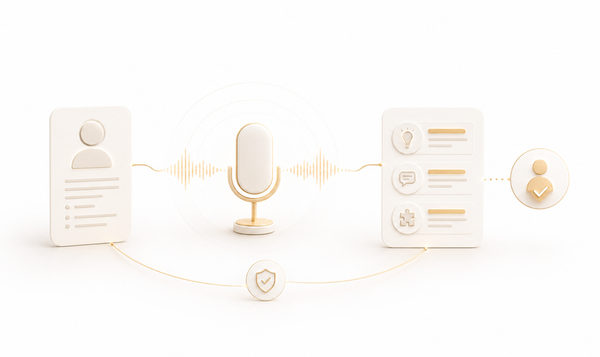
Personalization in voice communication does not require a human. It requires attention.
Attention to tone: the difference between a call that feels clinical and one that feels considerate is often as small as a phrase — "I want to make sure I have this right" rather than "please confirm."
Attention to pacing: the difference between a call that feels rushed and one that feels respectful is often the length of the pause before moving to the next question.
Attention to context: the difference between a call that feels generic and one that feels relevant is the acknowledgment of who the person is — what they asked about last time, what their situation is, why they are receiving this call.
None of these require a human voice. They require a system designed to care about the experience of the person on the other end.
The Scale Argument, Inverted
The conventional argument is that scale requires standardization, and standardization requires depersonalization. You cannot treat every person individually when you are reaching a hundred thousand of them.
The inverted argument: AI voice, at scale, allows you to treat every person consistently well in a way that humans cannot.
A human call center, operating at volume, delivers variable quality. The best agents are warm, attentive, and effective. The tired, undertrained, or overwhelmed agents are not. The customer experience is a distribution, not a standard.
AI voice, designed well, delivers the same quality on every call. The hundredth-thousandth interaction is indistinguishable from the first. Scale does not degrade the experience — it distributes it.
For enterprises where brand perception is built through customer interactions, consistency at scale is not a secondary benefit. It is a strategic one.
What This Demands of the Infrastructure
Delivering warmth and consistency at scale is not just a content design problem. It is an infrastructure requirement.
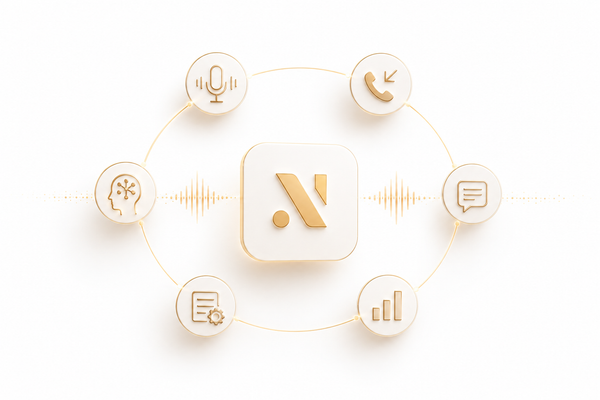
Natural-sounding TTS. Low-latency response so the conversation flows. Conversation design that anticipates how real people speak, not just how scripts are written. Escalation logic that recognizes when the interaction has exceeded what automation can handle well.
These are engineering decisions. They are also values decisions. They reflect a choice about what the system is for: processing volume, or serving people.
We build for the latter. The former follows.
NovaForge builds AI voice infrastructure designed to be indistinguishable from a good phone call — at any scale.