Beyond the Resume Screen: What AI Actually Hears in a Conversation
Hiring has a signal problem. The resume is optimized for filters, not for communication. AI voice screening doesn't replace human judgment — it gives human judgment better data to work with.
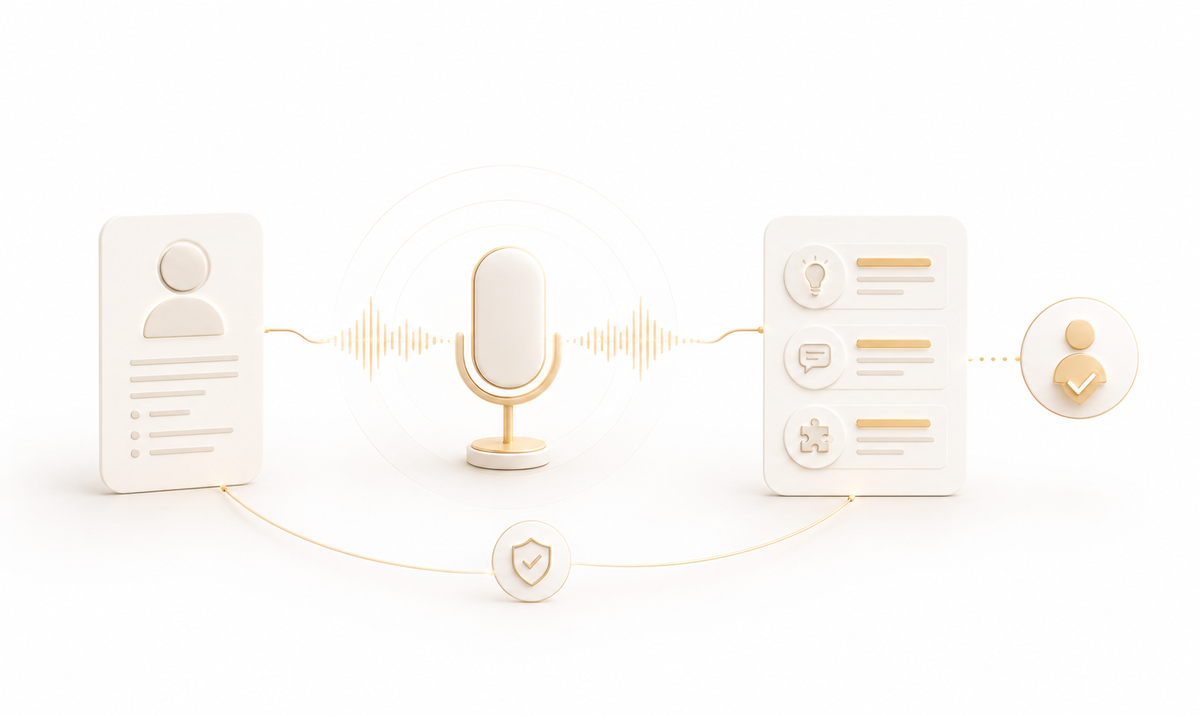
The resume tells you what someone has done. The conversation tells you how they think.
Hiring has a signal problem.
The resume is a highly compressed, retroactively curated document designed to pass through filters. It is optimized for selection systems, not for communication. It tells you what someone has done in the past, in the format most likely to match your requirements. It tells you very little about how they think, how they communicate, or how they will operate inside your organization.
Phone screening was designed to address this. But phone screening at volume is a resource problem. A recruiter can conduct 8 to 12 substantive screening calls per day. For organizations hiring at scale — hundreds of roles, thousands of applicants — that capacity constraint means most candidates are evaluated on their resume alone.
AI voice changes the constraint. And in changing the constraint, it changes what data is available for hiring decisions.
What a Conversation Contains That a Resume Does Not
Spoken language carries information that written language cannot.
Clarity of thought is revealed in real time, under the mild pressure of a live exchange, in ways that a carefully edited cover letter never can. How a candidate structures an answer to an ambiguous question tells you something about how they handle ambiguity. How they respond to a follow-up they did not anticipate tells you something about their adaptability.
These are not soft, unmeasurable qualities. They are observable behaviors — and in a structured conversation with consistent questions and documented transcripts, they become comparable across candidates.
AI voice screening does not just increase the volume of conversations. It standardizes the instrument. Every candidate answers the same questions, in the same order, with the same framing. The variance in responses is the candidate, not the interviewer's mood or the time of day.
The Explainability Requirement
There is a version of AI hiring that is a black box: a system that scores candidates without explaining why, producing rankings that cannot be interrogated or defended.
This is not the version worth building.
When a hiring decision affects someone's livelihood, the reasoning behind it must be articulable. Not just internally — to the recruiter, to the hiring manager, to the HR team — but potentially externally, to regulators, to candidates, to auditors.
AI voice screening that operates with explainability at its core produces documented reasoning for every evaluation. Not a confidence score. Not a ranking. A structured account of which responses, which competency signals, which behaviors contributed to the assessment.
This transforms screening from a selection mechanism into a defensible, auditable process — one that can be examined, challenged, and improved.
What This Means for Candidate Experience
The candidate experience of AI voice screening, when designed well, is not degraded relative to human screening. In many cases, it is better.
Candidates are screened promptly — not held in a queue for weeks waiting for recruiter availability. They receive consistent treatment — not varying quality based on which recruiter happens to call. They interact with a system that is focused entirely on their responses — not distracted, not rushed, not conducting five other screenings that day.
The key design requirement is that the conversation flows naturally. That the questions are clear and purposeful. That candidates feel heard. This is an engineering problem and a design problem simultaneously — and solving it requires native-quality TTS, thoughtful conversation architecture, and a system that treats candidates with the same respect any good interviewer would.
The Handoff That Makes It Work
AI voice screening is not a hiring decision. It is a data collection and qualification layer that makes human decision-making better.
The output of a well-designed screening conversation is not a hire/no-hire recommendation. It is a structured, documented, comparable data set that allows human reviewers to evaluate candidates with more information, more efficiently, and more fairly than a resume review alone.
The final judgment — the one that decides whether someone joins an organization — remains with the humans who will work with that person, lead them, and be accountable for the outcome.
AI provides the input. Humans make the call.
NovaForge provides AI voice infrastructure for structured hiring conversations — explainable, consistent, and designed to augment human judgment, not replace it.