How Banks Are Using AI Voice to Scale Customer Surveys
Most bank customers never respond to satisfaction surveys. Not because they don't have opinions — because the channel creates too much friction. AI voice removes that friction, and the data quality on the other side is fundamentally different.
The data was always there. The capacity to collect it wasn't.
Customer satisfaction is not a metric. It is a signal — and like all signals, it degrades when the collection mechanism is flawed.
For years, Turkish banks have run NPS surveys through SMS links and IVR systems. Response rates hover between 8 and 15 percent. The respondents skew toward the highly satisfied and the highly frustrated. The middle — the largest and most strategically important segment — goes silent.
That silence is not apathy. It is friction. The survey arrives at the wrong moment, through the wrong channel, in a format that feels like paperwork rather than a conversation.
AI voice changes the equation.
The Conversation Completion Rate Problem
A well-designed AI voice survey achieves completion rates of 60 to 75 percent in enterprise deployments — four to five times higher than digital alternatives.
The mechanism is straightforward: voice is the default human channel. When a customer receives a call that sounds natural, asks clear questions, and responds intelligently to their answers, they complete it. Not because they are obligated to. Because it feels like a conversation worth having.
This matters beyond the numbers. Higher completion rates mean less selection bias. Less selection bias means the data actually represents your customer base. And data that represents your customer base is the only kind worth making decisions with.
What AI Voice Adds Beyond Scale
Scale is the obvious benefit. A bank with 2 million retail customers cannot deploy human agents to conduct satisfaction surveys at any meaningful depth or frequency. AI voice removes that constraint entirely.
But the less obvious benefit is consistency.
A human caller's tone varies by shift, by fatigue, by the call before. An AI voice agent conducts the 10,000th interview with the same clarity and pacing as the first. In research contexts, that consistency is not a convenience — it is a methodological requirement.
The data collected by a consistent instrument is comparable across time. Which means you can track not just what customers feel today, but how that sentiment is moving — and why.
The Compliance Architecture
Banking is the sector where data architecture matters most. Customer interaction data carries regulatory weight. Where it is stored, how it is processed, who can access it — these are not IT questions. They are compliance questions with legal consequences.
This is where cloud-native voice AI solutions face a structural disadvantage in the Turkish market. KVKK places significant requirements on how customer data is handled, and in particular, on cross-border data transfers.
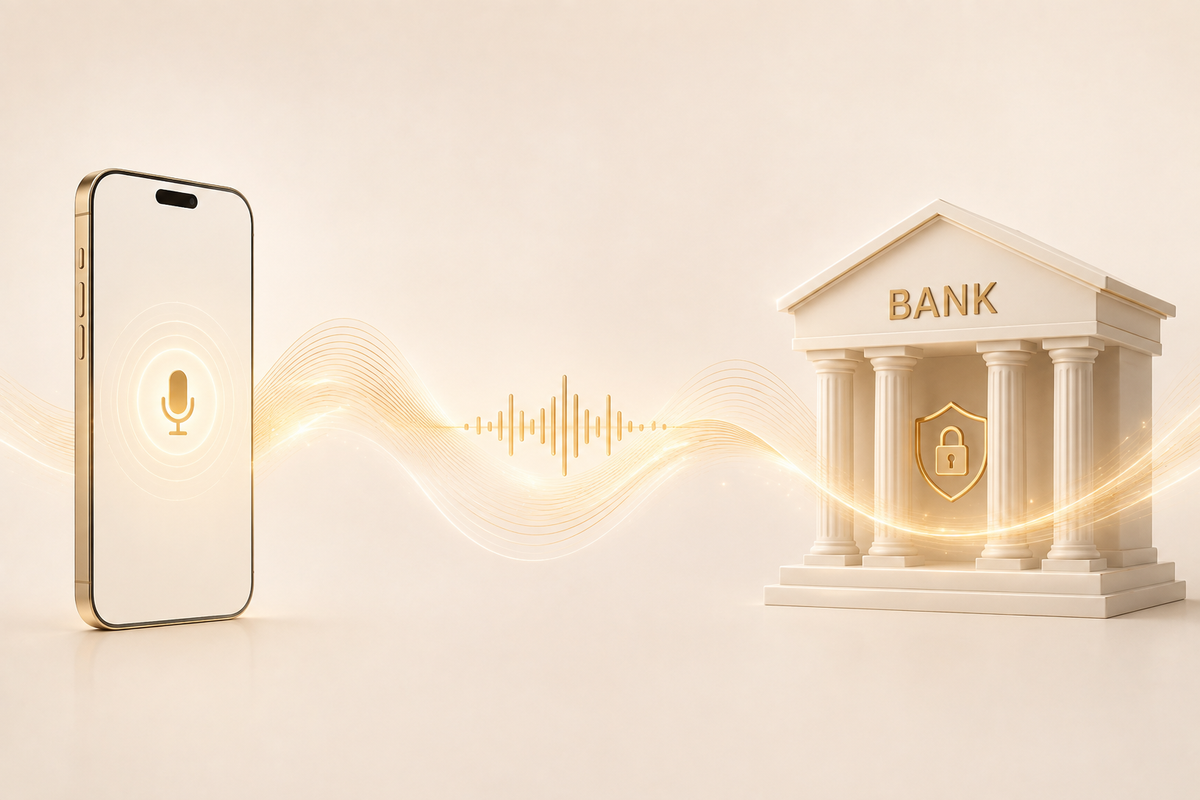
On-premises deployment resolves this. The voice infrastructure runs within the bank's own environment. No data leaves the institution's perimeter. The compliance posture is clean, auditable, and defensible.
What the Data Actually Tells You
The value of high-volume voice surveys is not just aggregate NPS. It is the qualitative texture beneath the scores.
When a customer says, in their own words, that the mobile app's transfer flow is confusing — that is product feedback. When the same sentiment appears in 3,000 conversations across a three-week period — that is a signal that justifies a sprint.
AI voice, combined with transcript analysis, transforms the satisfaction survey from a lagging indicator into an early warning system. The gap between customer experience and institutional awareness shrinks from quarters to weeks.
That compression is competitive advantage.
The Question Worth Asking
Not: can we afford to implement AI voice for customer surveys?
But: what is the cost of the data we are not collecting?
Every silent customer represents a decision made in the dark. Every biased response set is a strategy built on a distorted map.
The banks that move first on voice infrastructure will not just survey more customers. They will understand them better, faster, and more accurately than institutions still waiting for the link to be clicked.
NovaForge provides AI voice infrastructure for enterprise customer engagement — with proprietary Turkish TTS, on-premises deployment, and KVKK-compliant architecture.