The Call AI Should Never Make
Knowing what AI should not do is as important as expanding what it can. At NovaForge, the human handoff isn't an edge case we handle gracefully — it's a first-class feature we designed for from the beginning.
Knowing where automation ends is not a limitation. It is the design.
We are asked, sometimes, what Nova can do.
The more interesting question is what Nova should not do.
Not because the technology lacks capability. Modern voice AI can handle complex, multi-turn conversations with remarkable fluency. It can detect emotional tone, adjust pacing, respond to ambiguity, and navigate structured workflows at scale. The capability frontier is not the constraint.
The constraint — the one we designed deliberately — is accountability.
How Nova Actually Handles Questions
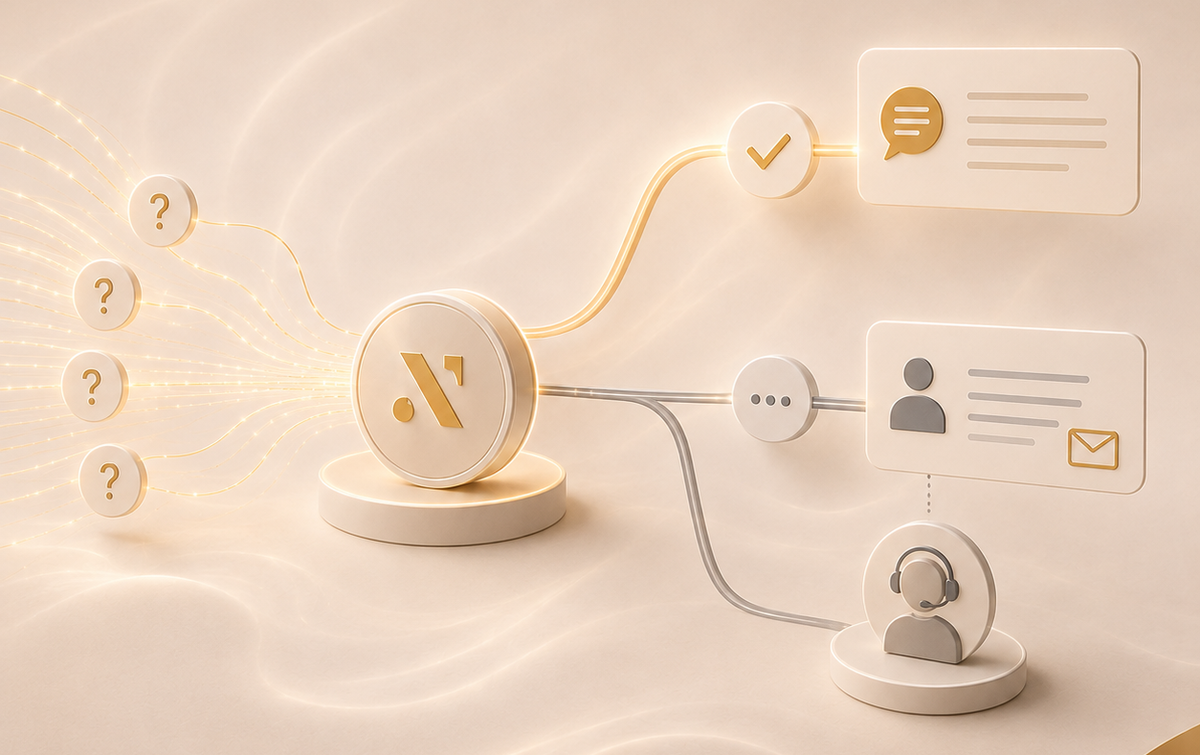
When Nova conducts a call, it works from a structured knowledge base: a defined set of questions the institution has approved, with answers the institution has verified.
When a caller asks something within that scope, Nova answers. Clearly, consistently, and without variation across the hundredth call or the ten-thousandth.
When a caller asks something outside that scope — a question the institution hasn't prepared for, an edge case, something that requires judgment the system hasn't been given — Nova doesn't guess. It doesn't improvise. It doesn't generate a plausible-sounding answer from thin air.
It says: I've noted your question, and someone will follow up with you on that.
And then it does exactly what it said. A notification is created. A human receives it. The follow-up happens.
Why This Matters More Than It Sounds
In enterprise voice AI, the temptation is to build a system that never admits a limit. That generates a response to everything. That keeps the caller moving forward at any cost.
This is the wrong design goal.
When an AI voice agent operating on behalf of a bank, a hospital, or an HR department improvises an answer it hasn't been authorized to give, the institution carries the consequence. A wrong answer about a loan product. A misstatement about a medical process. An inaccurate policy claim in a hiring context. The call ends. The damage doesn't.
A system that knows what it knows — and says so honestly when it doesn't — is not a lesser system. It is a safer one. And in regulated, high-stakes environments, safety is the architecture that makes everything else possible.
What This Creates for the Institution
The handoff mechanism does something beyond protecting against wrong answers. It creates a feedback loop.
Every question that falls outside the FAQ is a data point. Over time, that data tells the institution what callers are actually asking — not what the institution expected them to ask. The FAQ improves. Coverage expands. The system becomes more capable not through guesswork, but through deliberate, auditable iteration.
The questions Nova can't answer today become the questions it answers accurately next quarter.
The Trust Equation
Institutions that deploy AI voice without clear boundaries on what the system can and cannot answer are not just taking a compliance risk. They are taking a trust risk that is harder to recover from.
When a caller feels that an automated system made something up to get them off the phone, they remember it. The memory is corrosive. It colors every subsequent interaction with the institution.
Conversely, when an AI system says I don't have that answer but someone will get back to you — and then someone actually does — the caller experiences something unusual: an automated system that was honest about its limits and kept its word.
That is not a small thing. In voice communication at scale, that is how trust compounds.
Not a Limitation. A Commitment.
There are vendors who will tell you that AI can handle everything. That the models are capable enough, the risk is manageable, the edge cases are rare.
We are not those vendors.
We believe that defining what AI should not answer is as important as expanding what it can. That a system built with principled limits — and a reliable mechanism for what happens when those limits are reached — is more trustworthy than one built without them.
The call AI should never make is not a gap in our product. It is a feature of our values.
NovaForge builds AI voice infrastructure with human-first design — because the strongest automation knows exactly where it should stop, and what to do when it gets there.